
Teaching today isn’t easy. Professors face more challenges than ever as students expect lessons that are practical, engaging, and relevant to real-world careers. Traditional textbook-based methods often aren’t enough to meet these needs. To get a better sense of how educators can adapt, we spoke with Barb Waters, MBA, PMP, and author of the Essentials of Project Management curriculum.
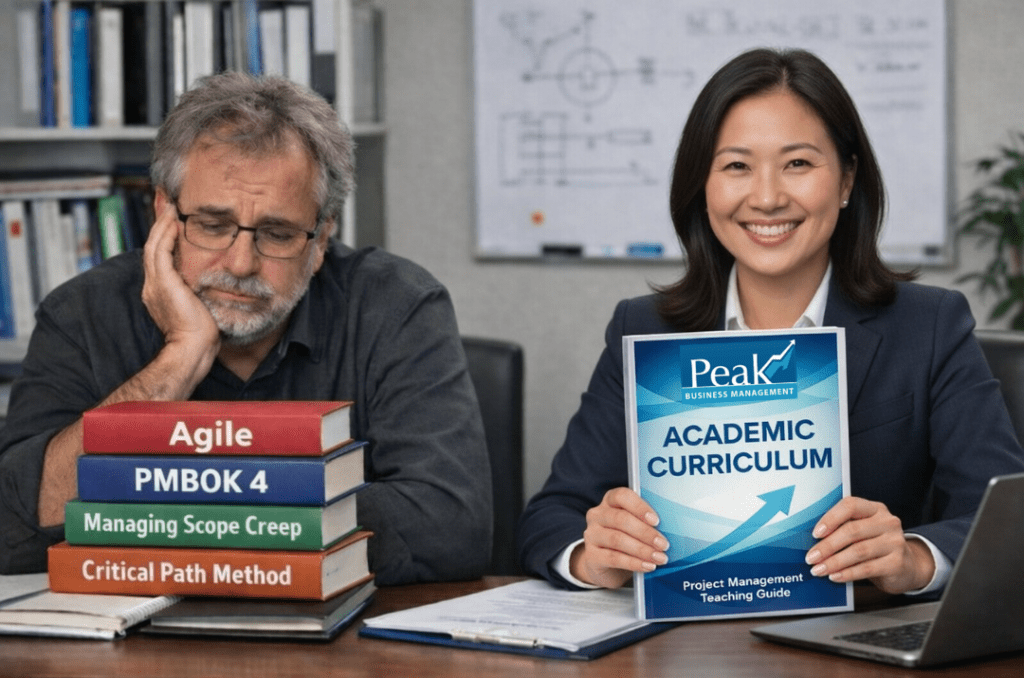
Drawing on her experience in both teaching and the project management field, Barb explains how her early struggles as a professor inspired her to create a curriculum that is flexible, hands-on, and designed to deliver real results for students.
As a new project management professor back in 2013, I struggled to find a textbook that was engaging, affordable, and at the right level for my students. Because of that, I ended up creating a lot of my own slides and content, drawing on my PMP certification and real-world experience as a project manager. My students responded well to it, and I could see how well they were learning, so I continued.
I’ve been PMP-certified since 2012 and have spent decades working in project management roles. Since launching the curriculum, I’ve continued to evolve it alongside the field. We’ve gone through three new editions of the PMBOK Guide, and I’ve expanded my expertise with Agile and Scrum certifications. I’ve also grown as a content developer through my work with Skillsoft, a leading learning provider trusted by about 60% of the Fortune 1000. I credit that experience with strengthening my approach to curriculum design.
For more information see Barb’s LinkedIn profile.
Because our clients often come to us with outdated textbooks that do not reflect real business scenarios, we use global benchmarks to get them back on track right away.
We align the curriculum with standards set by the Project Management Institute (PMI). The PMP certification is widely considered the global gold standard in project management. Specifically, we use the PMP certification as our benchmark, ensuring the content stays aligned with the exam content outline, which is regularly updated based on input from practicing project managers to reflect how the role is evolving in the real world.
One of the biggest strengths of the curriculum is its flexibility. It’s designed to meet professors where they are and adapt to a variety of teaching environments. It can be delivered over anything from five to fifteen weeks, depending on your schedule.
You can teach it live using slide decks with instructor notes, use narrated videos for a more self-paced experience, or blend both approaches. It works just as well in person as it does online, and assignments can be tailored for undergraduate or graduate-level rigor. It also supports both credit and non-credit use, so it can fit into traditional academic programs as well as professional development or certificate offerings.
| Format | Duration | Engagement |
| In-person or virtual, live or self-paced, credit or non-credit | 5-15 weeks, we adapt to your schedule | A wide variety of supplemental videos, quizzes, and workshops |
We usually recommend starting by looking at what you’re currently using. Whether it’s a textbook, slide decks, or something else, ask yourself what’s really working and what isn’t.
As adjunct professors, it’s easy to settle for “good enough” because making a curriculum change can feel like a lot of extra work, often without much support. There’s also the concern about adding costs for students, which can make you feel stuck. But a strong curriculum shouldn’t feel like a burden. It should feel like something that actually makes your job easier.
Think of us as your own teaching assistant. If you have questions or need clarification on anything, we are a phone call or email away.
Watch Academic Curriculum DEMO